Highwoods Preservation Society
Reg. Charity No:
282289
How to find us
Join as a
Member
Member
Events
reports / next
reports / next
HOME
Horse Bridge
Horse-bridge problem
WHAT to do about the old horse-bridge? That has been a question which has concerned the Society’s committee for a considerable time.
By necessity, the wooden bridge which carries horses and riders over the ghyll and stream at the upper point in the woods has to bear a considerable weight. It’s upkeep and its safety are therefore paramount.
The age of the bridge is somewhat indeterminate but it may well date from shortly after the Society’s inception and its taking over the care of the Highwoods in 1980.
Though constructed of extremely stout timbers, both in chronological terms and in sheer practicality it has long been judged to be “well beyond its sell-by date.”
Over the years, the Society has considered a number of remedial measures, ranging from demolition and replacement to removal and its substitution with a simple ford.
Now the work-party has taken action and the end result could be something completely different in concept.
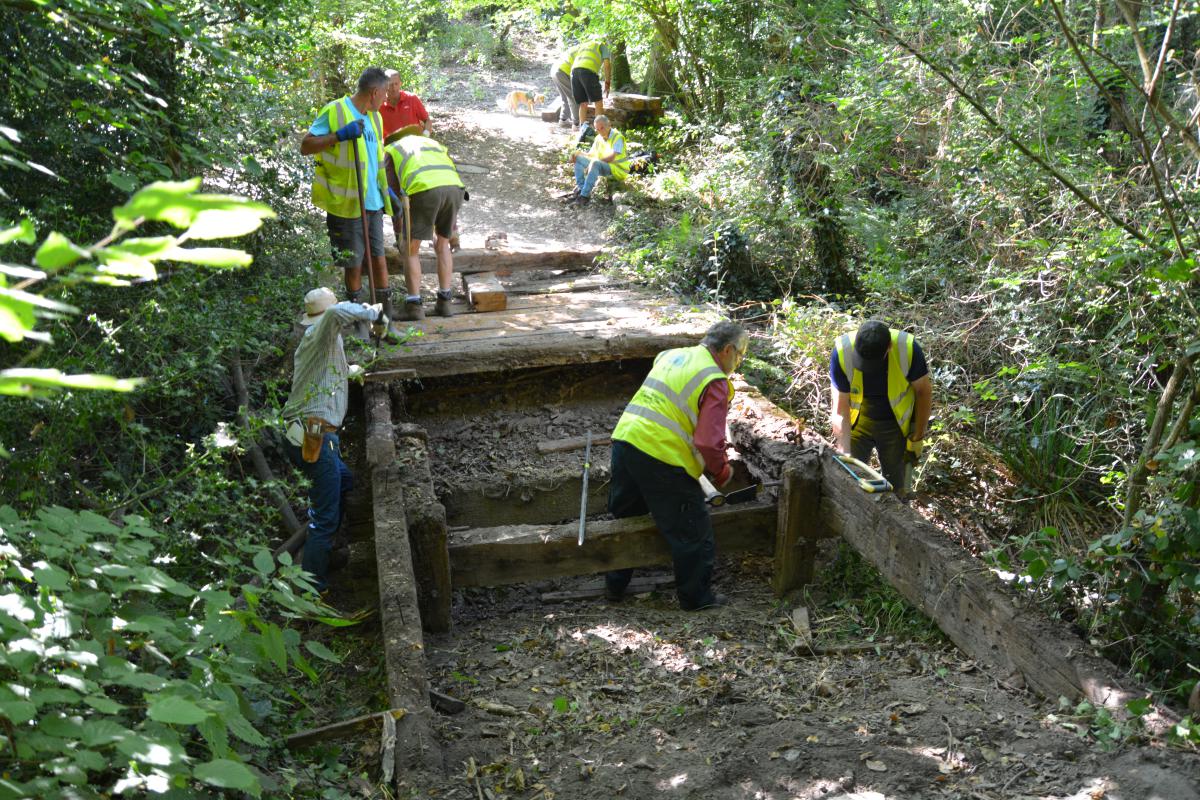
In one of their swiftest and most decisive moves, the work-party on Saturday. August 1st set to with crowbars and sheer manpower.
Plank by massive plank, the horse-bridge on the White (i.e. horse) Trail was systematically dismantled in a remarkably short space of time. Given the dimensions of the timbers involved, this was no mean feat.
As the huge planks and their supporting timbers were removed and stacked elsewhere the extent of the problem and the need for a remedy were immediately apparent.
Significant rot had set in. It really had been time for the old bridge to go.
So, how to replace it?
It retrospect, the bridge’s scale can be seen to have been a classic example of “taking a sledgehammer to crack a nut” for even in a wet winter, the stream is tiny.
Bridge removal was conducted during one of the longest droughts on record. The stream which burbled down the ghyll during the preceding equally extreme winter had long-since dried.
In order to cope with the anticipated flow next winter, the Wardenship Group have come up with a cunning plan. That is to abandon the idea of a bridge and instead insert a length of large-bore pipe and then pack in soil on it to raise the ultimate level to something near the White Trail’s approaches and top this with crushed stone. Side timbers would help the structure retain its integrity.
A busy morning was complemented by work on improving the drainage trench running alongside the nearby steps which carry the Horse Trail down towards the bridge. This is aimed at diverting water away from the steps during wet weather.
Highwoods SSSI
NEXT EVENT